If you manage an apartment community, sit on an HOA board, or own commercial property in Greater Houston, a pool is rarely just a pool. It is an amenity residents judge you on, a line item the board has to defend, and a regulated facility with its own inspection schedule.
Most people who end up responsible for one have never built anything like it before.
This guide walks through what commercial pool construction actually involves — the phases, the approvals, the realistic timeline, and the questions worth asking before anyone signs anything. No sales pitch, just the shape of the process.
What Counts as a “Commercial Pool” in Texas?
The line is not about size or luxury. In Texas, a pool is regulated as a public pool when it serves people beyond a single household — which sweeps in a lot of projects owners assume are private.
That typically includes:
- Apartment and multifamily community pools
- HOA and subdivision amenity pools
- Condominium and townhome pools
- Hotel, RV park, and club pools
- Fitness center, school, and municipal pools
A backyard pool at a single-family home is not in this category. An eight-unit fourplex pool usually is.
Why it matters: public pools carry design, safety, sanitation, and operator requirements that residential pools do not. The Texas Department of State Health Services maintains the standards for public swimming pools and spas, and local health departments handle plan review and inspection. Getting classified correctly on day one shapes everything downstream.
Who Actually Owns the Decision?
On residential projects there is usually one decision-maker. On commercial projects there are almost never fewer than three, and the friction between them is the single most common reason schedules slip.
HOA boards answer to homeowners and usually to governing documents that dictate how amenity spending gets approved. Expect a vote, and expect it to take a meeting cycle or two.
Property owners and asset managers are weighing the amenity against lease-up, renewals, and a return horizon. They tend to move faster but want the numbers framed differently.
Property managers live with the result every day and know things the other two don’t — where residents actually congregate, what maintenance has been a headache, what complaints repeat.
A builder who only talks to one of the three is going to design the wrong pool. We would rather be in the room with all of them early, even when that makes the first conversation longer.
The Five Phases of Commercial Pool Construction
Every project moves through the same sequence. The names change from builder to builder; the work does not.
1. Discovery and concept. Site walk, existing conditions, resident demographics, what the amenity is supposed to accomplish. This is where you decide whether you are building a lap pool, a family pool, a resort-style amenity, or a splash pad instead.
2. Design and engineering. Layout, depths, decking, circulation, mechanical, electrical, and drainage. Structural and hydraulic engineering happens here.
So does the accessibility question, and it is worth settling early.
The Department of Justice’s guidance on accessibility requirements for swimming pools draws a clear line. Community pools limited to residents and their guests are generally not covered by ADA Title III. Pools rented out to the public, or owned by a government entity, are.
Accessible entry is a design decision, not something to bolt on at the end. Get the classification right before drawings are final.
Seeing the space before it exists helps enormously at this stage. Our 3D pool design process lets a board walk the amenity and change their minds while changing their minds is still free.
3. Plan review and permitting. Drawings go to the local health authority and the city or county. Review takes as long as it takes, and it is the phase least under anyone’s control. Complete, correct submittals move faster than optimistic ones.
4. Construction. Excavation, steel, plumbing, shell, mechanical, finish, decking, fencing, and safety equipment — with inspections at defined checkpoints. On an occupied property, phasing and site safety are as much of the job as the pool itself.
5. Start-up, inspection, and handoff. Fill, water balance, equipment commissioning, final inspection, signage, and operator documentation. Texas requires a trained and certified operator for public pool facilities, so this phase includes making sure someone on your side is ready to run it.
What Multifamily Projects Demand That Backyard Pools Don’t
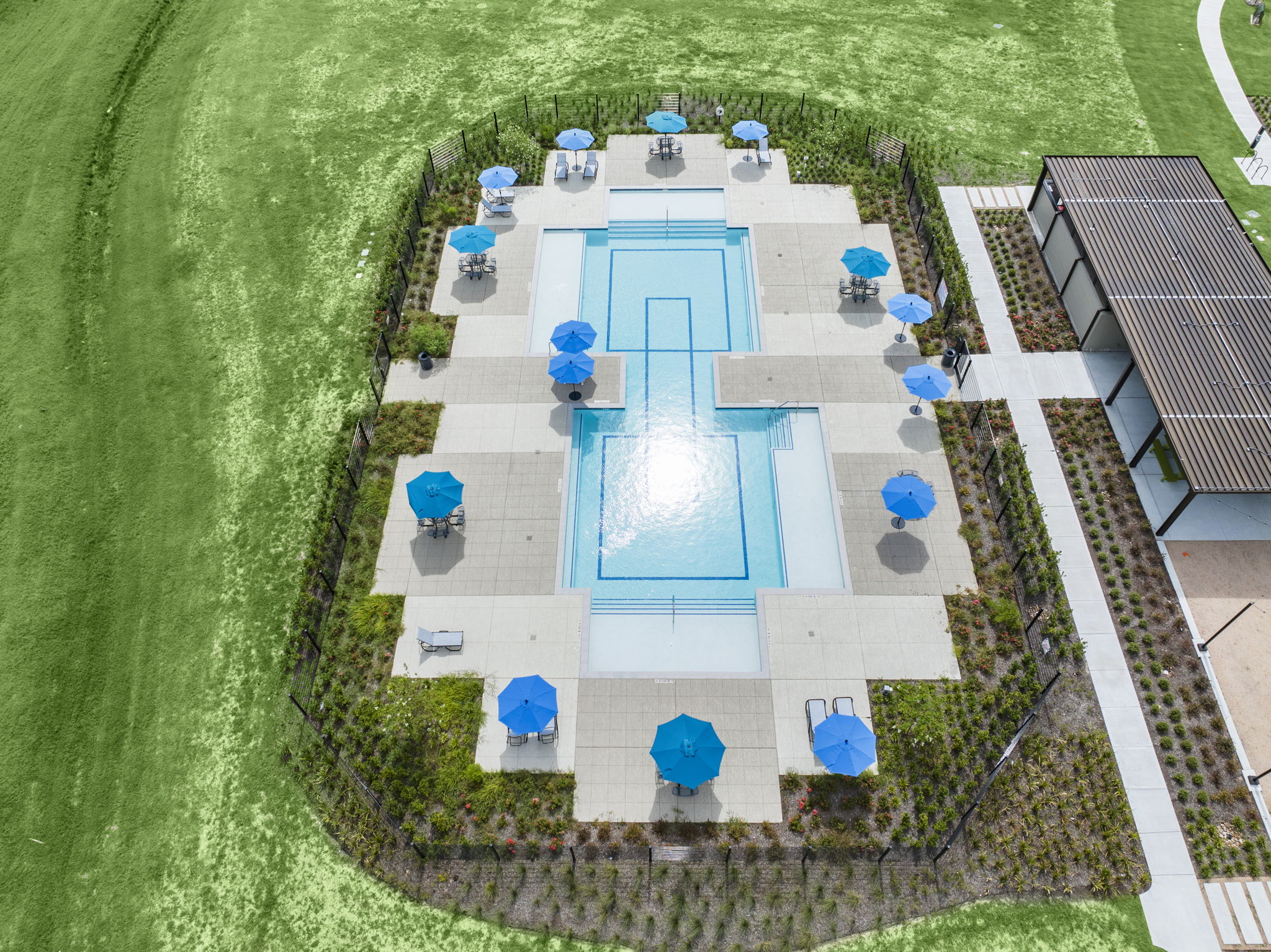
This is where commercial pool design genuinely diverges from residential work.
Circulation and turnover are sized to bather load, not to gallons. A pool that serves 300 apartments needs a system built for a Saturday in July, not an average Tuesday.
Sight lines matter in two directions. Residents in units above look down on the amenity every day, so the deck plan and equipment screening are visible design decisions. Management also needs unobstructed views across the water for supervision.
Depth strategy drives use. A single uniform depth is easy to build and mediocre for everyone. Shallow lounge shelves, a defined zero-to-shallow zone, and a swimmable middle serve a community far better than one flat basin.
Deck space is the amenity. Owners consistently underestimate how much of the resident experience happens out of the water. Shade structures, lounge zones, and circulation width around the coping do more for satisfaction than a few extra feet of pool.
Everything is inspected. Barriers, gates, latches, depth markers, signage, drain covers, and lighting all have requirements. Building to them from the drawing stage is far less painful than correcting them after a failed inspection.
If you are early in the process, our guide to the first 90 days of HOA community pool planning covers the front end of this in more depth, and amenity-first design covers how to decide what to build before deciding how big.
How Long Does It Take to Build a Commercial Pool?
The honest answer is that construction is rarely the long pole.
A reasonable planning frame for a Greater Houston commercial project looks like this:
- Discovery and design: several weeks to a few months, depending on how quickly decisions get made
- Board or ownership approval: one to two meeting cycles
- Plan review and permitting: highly variable by jurisdiction
- Construction: several months, weather-dependent
- Start-up and final inspection: a few weeks
Add those up and a community targeting a Memorial Day opening is making the decision the previous fall. Not because construction takes that long, but because approvals and permitting sit in front of it.
Boards that start in March for a May opening are, in almost every case, opening the following year.
What Drives the Cost of a Commercial Pool Project
We do not publish price ranges, because a number without a scope attached is misleading. What we can tell you is what actually moves the total, so you can read any proposal more critically:
- Size and depth profile — volume drives excavation, shell, chemistry, and equipment sizing together
- Site conditions — access for equipment, soil, drainage, existing utilities, and demolition
- Circulation and sanitation system — sizing for peak bather load, and the treatment approach chosen
- Deck scope — square footage, material, drainage, and shade structures
- Accessibility and code items — entries, barriers, signage, and safety equipment
- Features — shelves, benches, water features, lighting, and any splash-pad element
- Phasing on an occupied property — working around residents costs schedule, and schedule costs money
The most expensive commercial pool is usually the one that gets value-engineered in the wrong places and needs rework in year three.
Questions to Ask Before You Sign
Bring these to any builder you are considering, including us:
- Have you built public pools in Texas, and can we see them?
- Who does your structural and hydraulic engineering?
- How do you handle plan review with our specific jurisdiction?
- What does your inspection checkpoint schedule look like?
- How will you phase work on an occupied property?
- What is included in start-up, and what documentation do we receive at handoff?
- Who do we call in year two?
A builder who answers these easily has done it before. One who gets vague around permitting and inspections is telling you something.
Building Across Greater Houston and College Station
We build community and commercial pools across the Houston metro — including Katy, Spring, Tomball, The Woodlands, and Houston proper — and out to College Station and Bryan.
That geography matters more than it sounds. Plan review, inspection practice, and permitting rhythm are not identical from one jurisdiction to the next, and a builder who works across the region regularly knows where the friction usually is.
Frequently Asked Questions
Is an apartment complex pool considered a commercial pool in Texas? Yes. A pool serving multiple households — an apartment community, HOA, condominium, or townhome development — is regulated as a public pool, with design, safety, and operator requirements that a single-family backyard pool does not carry.
How long does it take to build a commercial pool? Construction itself typically runs several months, but the full project — discovery, design, approval, plan review, permitting, construction, and start-up — is best planned as a multi-season effort. Communities aiming to open by Memorial Day generally start the conversation the previous fall.
What is the difference between commercial pool design and residential pool design? Commercial design is driven by bather load, supervision sight lines, accessibility requirements, and inspection standards. Residential design is driven by one family’s preferences. The engineering, the equipment sizing, and the documentation are all materially different.
Do we need a certified operator once the pool is open? Texas requires public pool and spa facilities to have a trained and certified operator. Current requirements are published by the Texas Department of State Health Services in its laws and rules for public swimming pools and spas.
We make sure this is addressed at handoff rather than discovered at the first inspection.
Can a splash pad work instead of a pool for our community? Sometimes, and for communities with a lot of young families it can be the better fit. The trade-offs are real in both directions — we walk boards through that comparison rather than steering it.
What should our board do first? Define what the amenity is supposed to accomplish before anyone draws anything. Who uses it, when, and what problem it solves for the community. Design decisions get much easier once that is written down.
Ready to talk it through?
If your board, ownership group, or property team is considering a new community pool in Greater Houston or College Station, we would welcome the conversation — including the early, nothing-decided-yet version of it.
Explore our commercial pool services or get in touch · 713-701-9550
Still Water Pools · 8900 Eastloch Dr Bldg 310, Spring, TX 77379