A new community pool is one of the most visible amenities your HOA or multifamily property will ever build. It becomes the place families gather in the summer, where residents bring guests, and where first impressions are made during tours.
But the best community pools are not designed by starting with a shape. They are designed by starting with a question:
Who actually swims here — and how do they want to use the space?
This guide is written for HOA boards, property managers, and multifamily owners planning a new-build community pool across Greater Houston (primary) and College Station/Bryan. The goal is to help you think through amenity-first design decisions that support safe, enjoyable use for the residents you serve.
Start with your swimmer mix (this drives everything)
Before locking in a shape or scope, map out who will actually use the pool. The same pool that delights a family-heavy neighborhood may underwhelm an empty-nester community, and vice versa. Think about the following user groups in your community:
- Families with young children (toddlers and pre-swimmers)
- School-age kids and teens
- Adult lap swimmers and fitness-focused residents
- Social gatherers (groups, parties, weekend hangouts)
- Seniors and residents who benefit from low-impact water exercise
Once you know your mix, the design decisions in the rest of this guide get a lot easier — entry style, depth profile, deck layout, splash features, and lighting all follow from who swims here.
Entry design: zero-entry vs. steps vs. multiple access points
How residents get in and out of the pool is one of the most under-discussed design choices. The right answer depends on your swimmer mix and how much space you have to work with.
Zero-entry (beach entry)
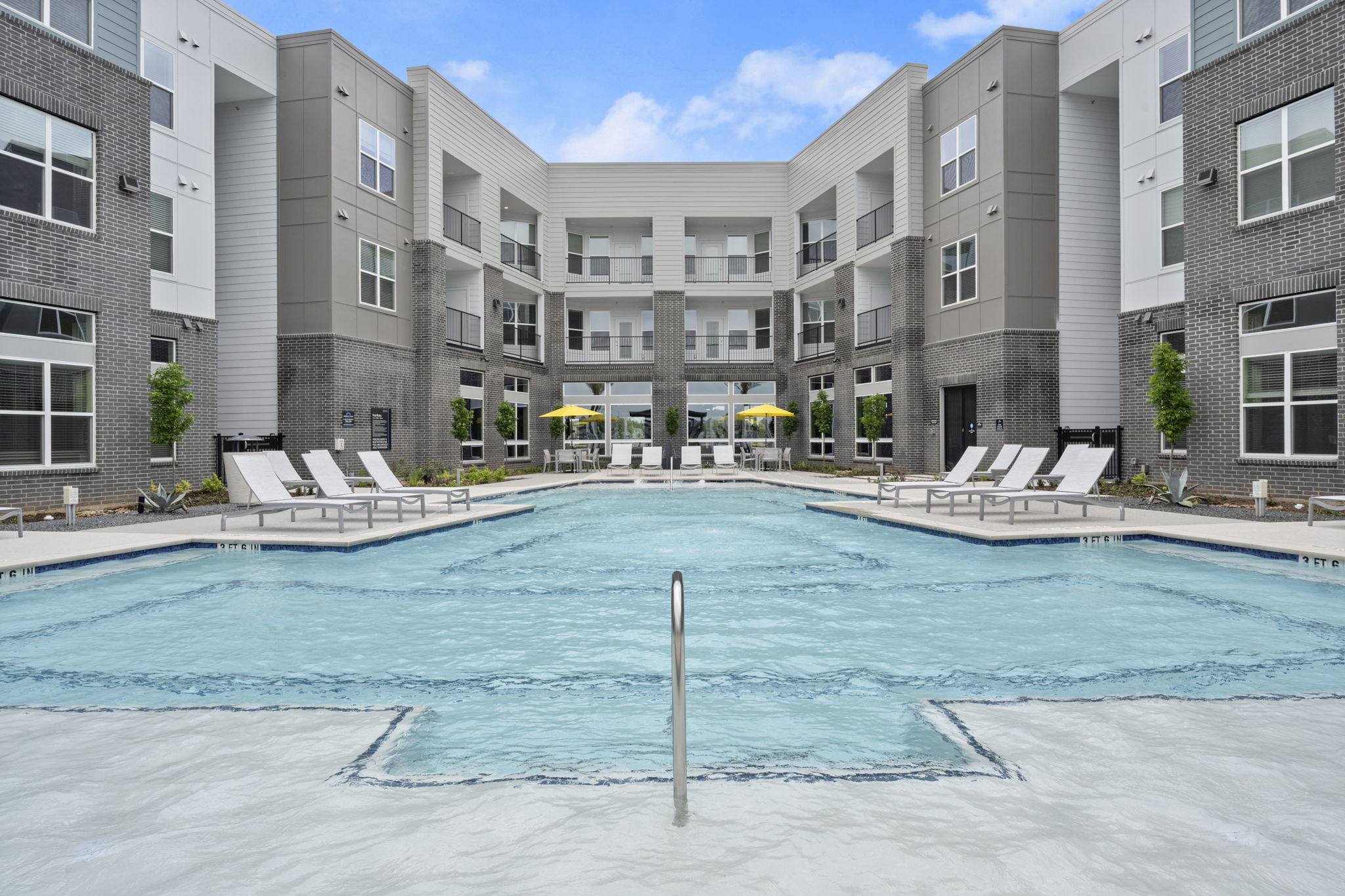
A gently sloped, walk-in entry that mimics a beach shoreline. Excellent for families with toddlers, residents with limited mobility, and supports ADA accessibility goals. Requires more surface area than steps, so plan for a larger overall footprint.
Steps and benches
Traditional staircase entry with built-in benches. Lower cost, smaller footprint, works well in tighter sites and adult-leaning communities. Pair with a separate ADA-compliant access option if zero-entry is not in scope.
Multiple entry points
For larger community pools, multiple access points reduce traffic bottlenecks at peak hours and create natural zones (family side, lap side, lounge side). Especially helpful at amenity-heavy properties where the pool is one of several gathering points.
Recreation vs. lap use: decide early (and design for both when possible)
Communities that serve both recreational and lap swimmers need to choose between separating uses or designing for both at once. A few patterns that work well:
- A dedicated lap lane along one side of an otherwise free-shape recreation pool
- An L-shape or T-shape that gives lap swimmers a clear straight section while families use the wider end
- Two adjacent bodies of water — a main pool plus a smaller dedicated lap pool or spa — when budget allows
Make this call early. Retrofitting lap-friendly geometry after construction is expensive and rarely as clean as building it in from the start.
Shade, seating, and deck space: the amenities residents feel most
Resident satisfaction surveys consistently rank shade and seating ahead of pool features themselves. The reason is simple: most residents at the pool are not in the water at any given moment. Plan deck and shade for that reality:
- Umbrellas and cabanas at lounger groupings
- Pergolas or shade structures over seating clusters
- A mix of single loungers, paired seating, and group dining tables
- Generous deck-to-water ratio — a rule of thumb is deck space at least twice the pool surface area for amenity-heavy properties
- Outdoor kitchen or grilling area if your community uses the pool deck for events
Real-world deck programming makes the pool feel like a destination rather than a feature.
ADA accessibility: build it into the plan, not as an afterthought
Community pools serving HOA and multifamily residents must meet ADA accessibility requirements. Plan compliance into the design from the first sketch — retrofitting later is almost always more expensive and less elegant.
- At least one accessible means of entry (a sloped zero-entry, a chair lift, or both for larger pools)
- Required handrails at steps and entry points
- An accessible path of travel from parking to the pool gate to the water
- Adjacent restrooms and changing facilities that meet ADA standards
Reference: ADA pool accessibility guidance from the U.S. Department of Justice covers the current requirements in detail. A qualified commercial pool builder will design to these standards by default.
Consider a separate kid splash zone (when families are a major user group)
If your community skews family-heavy, a dedicated kid splash zone — a shallow play area, a splash pad, or both — can dramatically improve the resident experience. It also reduces conflict between adult and child swimmers in the main pool. A few patterns:
- Splash pad with interactive water features, adjacent to but separate from the swim pool
- Shallow children’s wading area integrated into the main pool with a low spillway divider
- Stand-alone toddler pool with its own depth profile and seating sightlines
Splash pads are often funded as a separate budget line. If you are exploring this lane, our splash pad construction service page walks through what is typical.
Lighting for evening use: safety and community value
Lighting design directly affects both safety and the perceived value of your amenity space. A well-lit community pool stays in use longer in the evening and feels safer at all hours. Plan for:
- LED underwater lighting on the pool itself (energy-efficient and dimmable)
- Deck-level lighting around lounge and circulation areas
- Pathway lighting from clubhouse and parking to the pool entry
- Programmable scenes via automation (brighter for evening swim, ambient for off-hours)
- Emergency lighting that meets local code
Engage your designer on lighting layout early — conduit routing is much cheaper to plan than to retrofit.
Bathhouse adjacency and circulation: design the whole experience
The pool is part of an amenity sequence that starts at the clubhouse or parking lot and ends at a chair. The transitions matter. Consider:
- Bathroom and shower proximity to the pool entry (short, direct routes)
- Towel storage or distribution zones near the entry
- Optional lockers for multifamily settings
- Clear traffic flow between the clubhouse, the pool gate, and seating clusters
- Trash and recycling locations that staff can service without disrupting residents
Properties that design the whole sequence well consistently get better resident satisfaction reviews than properties that focus only on the pool itself.
Safety and healthy swimming: design choices that support good operations
Safety is not just a sign on the wall. It is built into the pool through design choices that make daily operations easier for property staff. Consider:
- Clear depth markers on the deck and pool wall at every transition
- Sightlines that allow staff or lifeguards to see the entire pool from a single position
- Strong filtration and chemistry systems sized for peak resident load
- Surface drainage that prevents standing water around the deck
- Slip-resistant deck finishes
- Fencing and gate hardware that meet local code for self-closing and self-latching
Reference: the CDC Model Aquatic Health Code covers best practices for design, construction, and operation of public aquatic facilities.
Service area note
Still Water Pools builds commercial and community pools across Greater Houston — including Spring, The Woodlands, Katy, Tomball, and Houston — and the College Station/Bryan area. If you are evaluating a builder for an HOA or multifamily project, we are happy to share comparable work from our project gallery.
Next step: plan an amenity your residents will actually use
Amenity-first design starts with one honest question about who swims at your property and ends with a pool that gets used the way you hoped it would. If your board or management team is considering a new-build community pool, we are happy to talk through your goals, walk through 3D pool design concepts, and provide a realistic path forward.