
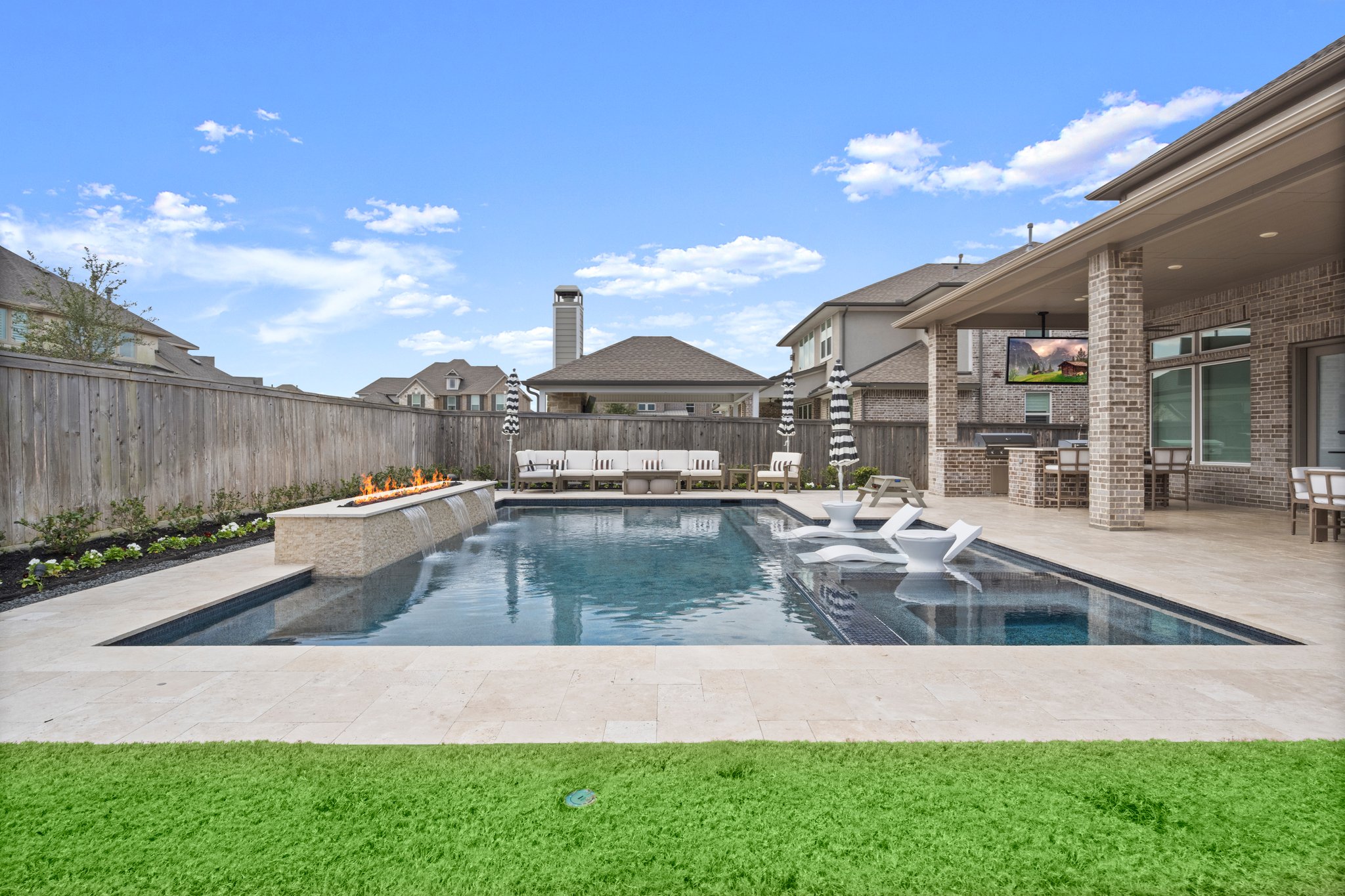
Ask a family what they love most about their custom pool a year after it’s built, and the answer is rarely “the deep end.” It’s the tanning ledge where the kids play and the lounge chairs sit half-submerged. It’s the spa that gets used on cool evenings ten months a year. It’s the quiet sound of water moving over a spillway.
These are the features that shape how a backyard actually gets used — and they’re all far easier (and more affordable) to build into the original design than to add later. Here’s a homeowner’s guide to the features we’re asked about most in Greater Houston, and what’s worth deciding early.
What is a pool tanning ledge (and is it the same as a Baja shelf)?
A tanning ledge — also called a Baja shelf, sun shelf, or sun ledge — is a wide, shallow platform built into the pool, usually holding a few inches to about a foot of water. Same feature, different names.
It’s become one of the most requested elements in custom residential pool design, and for good reason:
- For adults, it’s an in-water lounge — a place for chairs or loungers where you can stay cool without swimming.
- For young children, it’s a shallow, parent-visible play zone.
- For everyone, it’s the most-used “room” of the pool on a hot Texas afternoon.
In the Houston climate, where the pool season stretches from spring well into fall, a tanning ledge earns its footprint more than almost any other feature.
How big should a tanning ledge be?
Big enough for how you’ll actually use it. Two in-water loungers and an umbrella sleeve want roughly the footprint of a small patio; a toddler play zone can be more modest. Common depths run from a few inches to about twelve — deep enough to stay cool, shallow enough to stay a ledge.
This is exactly the kind of decision that benefits from seeing it before it’s built. Our 3D pool design process lets you walk the layout at real scale — ledge size, lounger placement, entry steps — and adjust while changes are still just a rendering.
Is a pool-and-spa combo worth it?
Homeowners often tell us the attached spa is the feature they use most across the whole year. A pool-spa combo pairs the summer pool with a heated spa that works on winter evenings, after long workdays, and on every cool night in between — it’s what turns a seasonal amenity into a year-round one.
Building the spa with the pool (rather than adding one later) also lets the design do more: a raised spa with a spillover edge doubles as a water feature, shares equipment and plumbing runs efficiently, and ties the whole composition together visually.
Which water features are worth adding?
Water features are less about spectacle and more about atmosphere. The ones we build most:
- Spillovers and sheer descents — a clean curtain of moving water; subtle sound, strong visual line.
- Deck jets and laminars — arcs of water from the deck into the pool; playful for kids, elegant at night with lighting.
- Bubblers — small fountains typically set into the tanning ledge; children love them, and they animate the shallow zone.
- Raised walls and scuppers — architectural features that pair well with modern designs.
A good rule: pick one or two features that fit the style of the home rather than a catalog of everything. Moving water should feel like part of the backyard, not a theme park.
Why do these features need to be planned early?
Three reasons:
- Structure and plumbing. Ledges, spas, and feature walls are formed and plumbed with the pool shell. Adding them after construction means cutting into a finished structure — significantly more cost and disruption.
- Equipment sizing. Spas and water features affect pump, heater, and automation choices. Right-sizing equipment from the start avoids paying twice.
- The design composes better. When the ledge, spa, and features are designed together, the pool reads as one intentional space. Bolt-ons look like bolt-ons.
If you’re earlier in the process and still mapping the overall project, our guide to the custom pool build timeline in Greater Houston walks through how design decisions like these fit the broader schedule.
Frequently asked questions
Does a tanning ledge take away swimming space?
It changes how space is allocated, so it’s a real design trade-off on smaller lots. Most families find the ledge gets more daily use than the swimming area it replaces — but this is exactly what 3D design review is for: see both versions and decide.
Can you put furniture on a tanning ledge?
Yes — in-water loungers and chairs designed for submerged use are standard. Plan the ledge depth and footprint around the furniture you want, and consider an umbrella sleeve for shade.
Do bubblers or deck jets require special equipment?
They run off the pool’s circulation system, but they need to be plumbed and valved during construction. This is why feature decisions belong in the design phase, not after.
Is a spa expensive to run year-round?
Modern gas heaters and automation make spa use on-demand — you heat it when you plan to use it rather than keeping it hot around the clock. Equipment choice matters, which is another early-planning advantage — pumps and heaters are the biggest energy draw in a backyard, and ENERGY STAR-certified pool pumps are worth specifying while the plan is still on paper.
Design the backyard your family will actually use
Still Water Pools designs and builds custom pools across Greater Houston — from Katy to The Woodlands — and the College Station/Bryan area. If you’re dreaming up a backyard with a tanning ledge, a spa, or a little moving water, we’d love to help you see it in 3D before ground ever breaks. Talk through your project with our team or call 713-701-9550.